8 Ways to Tone Your Vagus Nerve in Menopause (and Feel Calmer Fast)
What if calm wasn't something you had to wait for — but something you could switch on, in minutes, with your own body?
In menopause, your nervous system can feel like it's running a different program to the one you grew up with. A minor irritation lands like a five-alarm fire. Your heart races for no obvious reason. You feel wired and exhausted at the same time — and there's a reason for that. Your vagus nerve, the body's main calming pathway, is losing some of the support oestrogen used to give it.
The good news: the vagus nerve responds to direct, physical input. You don't have to think your way to calm. You can build it, on purpose, in under two minutes. Here are eight ways to do exactly that.
1. Extend Your Exhale
Your exhale is the vagus nerve's stand-down signal. Make it longer than your inhale and your body has no choice but to start settling.
Try this: Breathe in for a count of four, out for a count of eight. Repeat six times.
2. Hum, Sing, or Gargle
The vagus nerve runs right past your vocal cords and the back of your throat. Vibration there is one of the fastest ways to signal safety to your whole system.
Try this: Hum your favourite tune for thirty seconds, low in your chest, not up in your throat.
3. CV17 Tapping
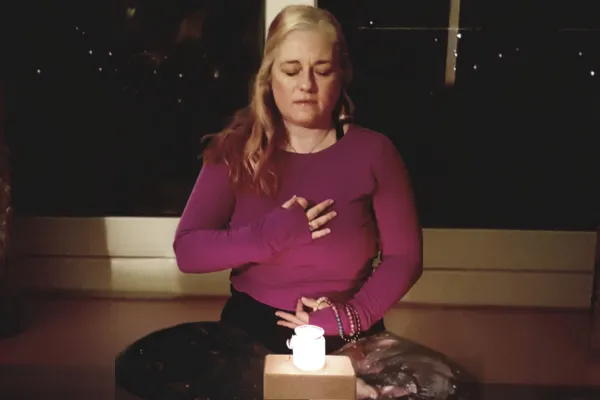
This point at the centre of your breastbone is known in Chinese medicine as the Sea of Tranquillity. Tapping here gently releases emotional holding and signals your nervous system to settle.
Try this: Fingertips to the centre of your breastbone, tapping lightly while you breathe in through the nose and out through the mouth. Eight to ten breaths.
4. Splash Cold Water on Your Face
Cold against the face triggers the dive reflex — an automatic, fast-acting calming response your body has had since birth.
Try this: Cup cold water and press it to your cheeks and forehead for ten seconds, or finish your shower with thirty seconds of cool water.
5. Move Rhythmically
Steady, repetitive movement — walking, swaying, rocking — has a naturally regulating effect on the nervous system.
Try this: Take a slow ten-minute walk with no destination and no podcast. Just the rhythm of your own steps.
6. Ujjayi Breath
The ocean-sounding breath I teach in every yoga class — a slight constriction at the back of the throat on both the inhale and exhale. The sound becomes an anchor, giving your nervous system something steady to hold onto.
Try this: Breathe in and out through your nose only, gently narrowing the back of your throat until you hear a soft, oceanic sound. Continue for eight breaths.
7. Reach for Face-to-Face Connection
Your vagus nerve is wired for connection. Warm eye contact and a familiar voice tell your body it's not facing anything alone.
Try this: Call one person today who makes you feel at ease. Even five minutes counts.
8. Hand on Chest
Warm, steady touch is one of the simplest ways to tell your own body it's safe. This is self-soothing in its most literal form.
Try this: Rest one hand flat on your chest and one on your stomach. Breathe slowly for a minute and feel your own warmth.
Where to Start
You don't need all eight today. Pick one. Do it for two minutes. Notice what shifts — your breath, your shoulders, the pace of your thoughts.
This isn't about eliminating stress. It's about giving your body a reliable way back to calm, one you control, any time you need it.
Go Deeper
Want to understand why your nervous system feels so different in menopause, and what's actually happening underneath? That's the full picture in How to Regulate Your Nervous System in Menopause.
And if you'd like one regulation practice a week, gently guided — that's exactly what my Sunday Soul letter is for. Short, real, grounded, straight to your inbox. Free. Click here to subscribe to Sunday Soul.


